 提交稿件/报价
 Information & Policy

Press
Open Source Academic Press Limited
Open Source Academic Press(OSA Press)出版国际同行评审学术期刊,并提供专业学术出版服务,包括编辑支持、翻译、排版制作及国际传播。通过标准化出版流程与结构化工作体系,我们为期刊与研究人员提供支持,提升学术成果的清晰度、质量与全球传播力。
Open Source Academic Press Limited  information@osapress.com
 Announcement
 Call for Papers-- ()
() invites researchers worldwide to submit high-quality manuscripts for upcoming issues.
Submit your manuscript today.
Please submit your manuscript by email to information@osapress.com.
 Contact Us
 Editorial Office
Editorial Assistant: Joyce Wang
Email: information@osapress.com
Publisher: Open Source Academic Press Limited (OSA Press)
Address: Unit B 22/F Arthur Commercial Building No.33 Arthur Street, Yau Ma Tei, Kowloon, Hong Kong
Email for Submission:
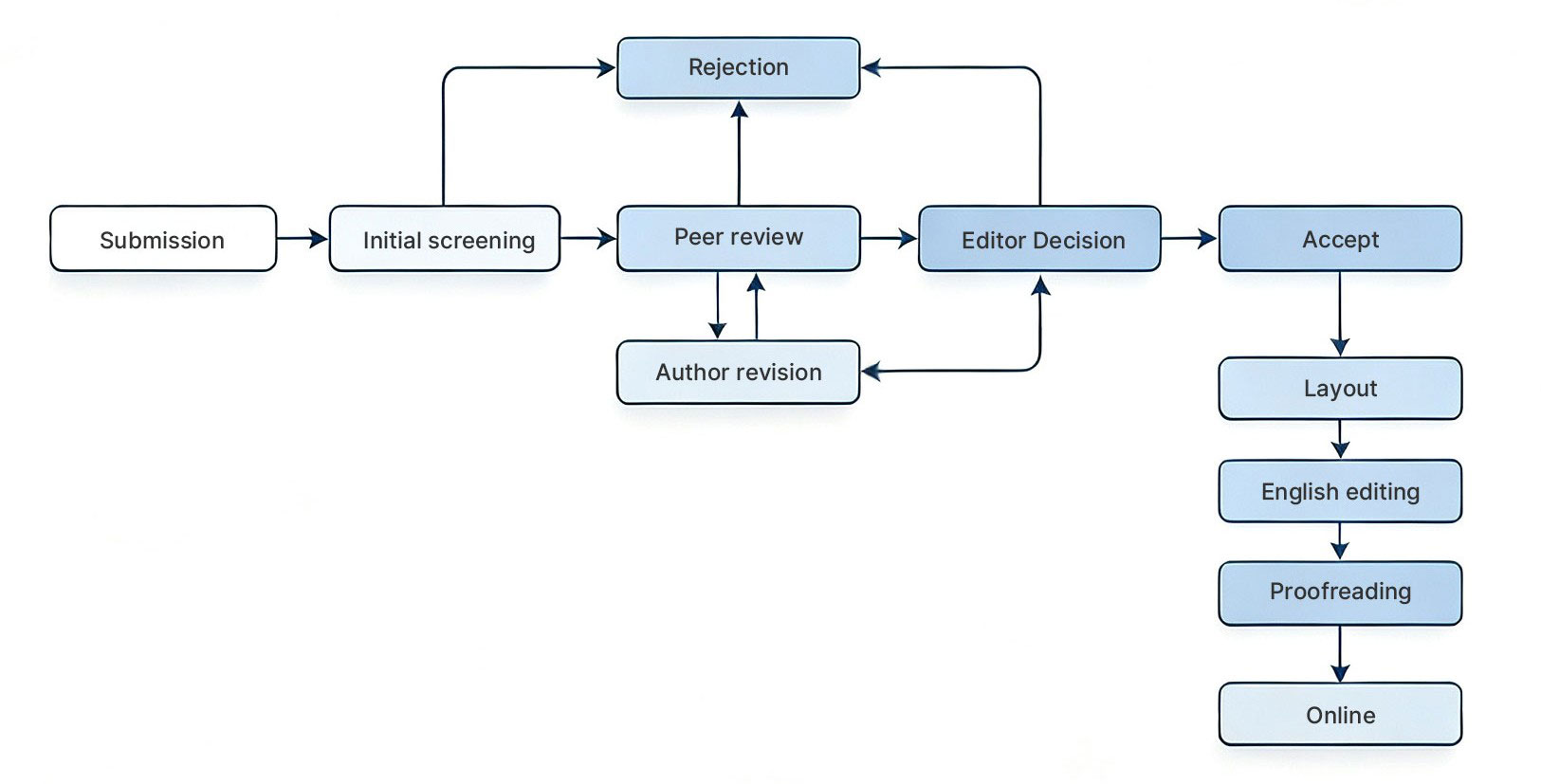
Upon submission, we will conduct an initial screening to ensure that the manuscript fits the scope of the journal and meets basic quality standards. Manuscripts that pass this stage will be sent out for peer review.
Please be aware that we check all submitted manuscripts for plagiarism. We use iThenticate to check for similarity to previously published documents. All manuscripts containing plagiarism, including self-plagiarism, and dishonesty are rejected.
Your manuscript will undergo a double-anonymised peer review process, where it will be evaluated by experts in your field. Reviewers will assess the quality, originality, and relevance of your research. You will receive feedback and may be asked to make revisions based on reviewer comments.
After peer review, you may need to revise your manuscript in accordance with the reviewers' comments. Please address all reviewer suggestions clearly in a response letter, detailing how you have incorporated the changes.
Once revisions are complete and your manuscript meets the journal's standards, the editorial team will make a final decision. If accepted, your manuscript will proceed to the production stage for publication.
OSA Press follows the International Committee of Medical Journal Editors (ICMJE) guidelines. To qualify for authorship, authors must meet all four criteria:
Those who contributed but do not qualify for authorship should be listed in the acknowledgments.
All submitted manuscripts should include an author contributorship statement using the CRediT taxonomy. Example format:
Conceptualization, X.X. and Y.Y.; methodology, X.X.; software, X.X.; validation, X.X., Y.Y., and Z.Z.; formal analysis, X.X.; investigation, X.X.; resources, X.X.; data curation, X.X.; writing—original draft preparation, X.X.; writing—review and editing, X.X.; visualization, X.X.; supervision, X.X.; project administration, X.X.; funding acquisition, Y.Y. All authors have read and agreed to the published version of the manuscript.
If a manuscript is submitted with a deceased author, the corresponding author should inform the Editorial Office and confirm the contribution and any potential conflicts of interest. Uponf publication, a note will be added under the author list.
Any proposed change to the author list—including the removal of individuals—requires formal approval from every author. The corresponding author acts as the editorial contact and bears the responsibility of updating co-authors on all significant editorial decisions, while ensuring their involvement throughout the process.
OSA Press recognizes the opportunities and challenges presented by Generative Artificial Intelligence (GenAI) tools, including ChatGPT and other Large Language Models (LLMs), in scholarly publishing. To promote transparency and research integrity, OSA Press has established the following policy.
Authors must disclose the use of GenAI tools when they have been used to generate text, data, graphics, study designs, or to assist with data collection, analysis, or interpretation. Details of such use should be described in the manuscript and acknowledged appropriately.
"During the preparation of this manuscript, the author(s) used [tool name and version] for [purpose]. The authors reviewed and edited the generated content and take full responsibility for the final published work."
The use of AI-assisted tools solely for language editing, grammar correction, spelling, punctuation, or formatting does not require disclosure.
Authors remain fully responsible for the accuracy, originality, integrity, and ethical compliance of all content submitted, including any content generated with AI tools.
AI tools and LLMs cannot be listed as authors, as they do not meet the requirements for authorship and cannot assume responsibility for published work.
Reviewers must not use GenAI tools to generate or evaluate peer review reports. Manuscripts, figures, tables, or any confidential materials under review must not be uploaded to AI systems. Limited use of AI for language editing of review reports may be acceptable but should be disclosed to the editorial office.
Editors must not use GenAI tools in editorial evaluation or decision-making processes. Confidential manuscript materials must not be uploaded to AI systems under any circumstances.
OSA Press's policy is to take a neutral stance in relation to territorial disputes or jurisdictional claims in published content, including in maps and institutional affiliations.
The Publisher and Editors are jointly responsible for maintaining the integrity of the published record through fair and timely investigations of alleged misconduct, transparent processes, and appropriate corrective actions.
Corrections are issued for honest errors that affect interpretation but do not invalidate overall findings. Examples include errors in figures or tables, mathematical errors that do not affect conclusions, incorrect affiliations, and minor methodology description errors. The Publisher and Editor review correction requests promptly and publish corrections in a timely manner. Corrections are linked bidirectionally with the original article and indexing services are notified.
OSA Press follows COPE retraction guidelines. Retractions are issued to correct the literature and alert readers to publications with serious concerns about integrity, validity, or reliability. Grounds for retraction include data fabrication or falsification, plagiarism, research conducted without ethical approval, unreproducible findings without adequate explanation, unethical authorship practices, and duplicate publication without disclosure.
Retractions may be initiated by authors, the Editor-in-Chief, the Publisher, authors' institutions or employers, funding agencies, or readers with compelling evidence. When authors refuse to retract despite clear evidence, the Editor or Publisher will issue the retraction independently.
All retraction notices include the title formatted as "Retracted: " followed by the original article title, complete citation, identification of who is retracting, clear and specific reason, date of retraction, and whether authors agree or disagree. Retracted articles remain online permanently with "RETRACTED" watermarks on every page, prominent banners, and clear links to retraction notices.
OSA Press makes all published articles immediately and globally accessible under an open-access license. This policy ensures that full texts are freely available to all users, and that any part of a publication—including figures and tables—may be reused without prior permission, provided the original source is clearly cited. Reuse does not, however, imply endorsement by the authors or by OSA Press. The costs of open-access publication are covered by the authors' institutions or research funders through a moderate Article Processing Charge (APC) applied only to accepted manuscripts.
All content published under the Creative Commons CC BY license may be freely reused with proper attribution. Additionally, authors are not required to seek special permission to deposit any version of their work—whether submitted, accepted, or published—into external repositories. These terms apply uniformly to all versions of the paper.
OSA Press upholds strict peer review standards to ensure the academic rigor, transparency, and integrity of all published work. Every journal under our imprint conducts thorough double-anonymised peer review, where both authors and reviewers remain anonymous throughout the process to promote fairness and objectivity.
All manuscripts submitted to journals published by OSA Press are subject to peer review before acceptance. We are fully committed to unbiased editorial processes that prioritize scholarly merit, methodological soundness, and relevance to the field.
All journals under our press implement a double-anonymised peer review model. This means:
Reviewers are expected to:
Editors act independently of commercial or institutional influence and base their decisions solely on academic merit. Where a conflict of interest arises, editors must recuse themselves from involvement with the manuscript.
Authors who wish to appeal an editorial decision or report concerns regarding the peer review process may contact the journal's editorial office. Appeals are reviewed carefully in accordance with our ethical standards and the guidelines of the Committee on Publication Ethics (COPE).
OSA Press is committed to safeguarding the integrity, transparency, and fairness of scholarly publishing. All participants in the publication process—authors, reviewers, editors, and the publisher—bear shared responsibility for upholding these ethical principles.
OSA Press also embraces the principles of inclusivity, social responsibility, and respect for diversity in all aspects of publishing. We encourage researchers from all backgrounds to participate in the scholarly dialogue and expect all parties to engage professionally and constructively throughout the publication lifecycle.
From the time of submission until formal publication, every manuscript is held in strict confidence. No editor or reviewer may share, cite, discuss, or otherwise reveal any part of a submitted work without the explicit written permission of the corresponding author.
All correspondence and materials generated during the review process—including reviewer reports, editorial decision letters, and related exchanges—remain permanently confidential. Reviewers are required to destroy or return all copies of manuscripts in their possession once their review is completed.
For journals operating under a double-anonymised peer-review model, access to authors' identifying information is restricted to editors and reviewers only to the extent necessary for evaluation, and such information is handled with the utmost discretion.
Any personal data submitted to OSA Press—whether by authors, reviewers, or editors—are processed in accordance with our Privacy Policy and all applicable data protection regulations. Individuals may request access to, correction of, or deletion of their personal data by contacting our privacy office at privacy@osapress.org.
Special Issues are curated collections of articles focused on a specific research theme or emerging topic. They are managed by appointed Guest Editors—subject experts who oversee the editorial process for submissions within the scope of the Special Issue.
Unlike traditional issues, Special Issues are not published as standalone volumes. Instead, accepted articles appear within the journal's regular issues but are clearly grouped and labeled under the relevant Special Issue both online and in metadata.
Special Issues help amplify focused scholarly conversations, promote topical visibility, and enhance discoverability through thematic coherence.
All submissions to Special Issues undergo the same rigorous editorial and ethical procedures as standard submissions:
To propose a Special Issue, please download and complete our [Special Issue Proposal Form] (PDF/Word), and send it to: information@osapress.com
For further assistance, you may also reach out to the Editorial Office of the specific journal to discuss your idea prior to formal submission.